🎥 Prefer to watch instead? I break this down on video — watch "Why Isn't My House Selling in Little Rock?" here: https://youtu.be/W-AzP9Zb7tU. Subscribe to Arkansas Real Estate Advisor for weekly Central Arkansas breakdowns.
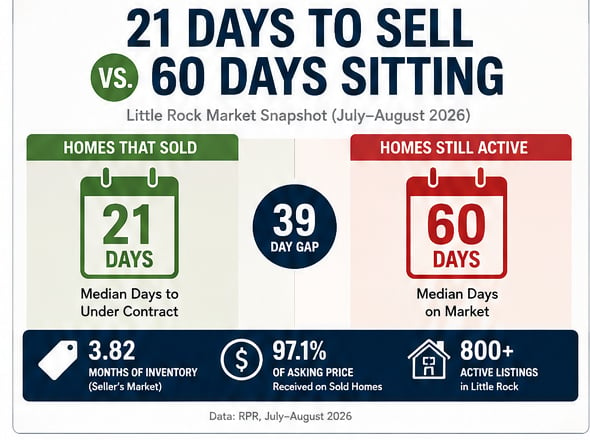
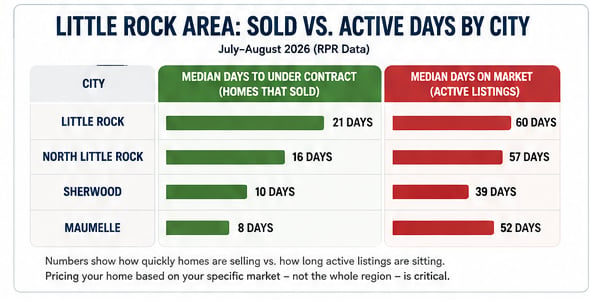
Short answer: it's almost never "the market." In Little Rock, homes that actually sold in July went under contract in a median of 21 days. Homes still sitting on the market had been listed a median of 60 days. Same city, same month, two completely different numbers.
That 39-day gap tells you nearly everything you need to know about selling a house here right now.
I'm Zach Dunivan, a Realtor in Central Arkansas. When a listing stalls, the easiest explanation is to blame rates, or buyers, or the season. There's some truth in all of it. But the market isn't slow — it's separating. It's separating the houses buyers want at the price being asked from the houses they don't.
So the question isn't "why won't anybody buy a house?" It's "why are buyers choosing the other houses instead of mine?"
Market data from RPR, July and August 2026.
The Little Rock market is not dead
This matters, because sellers make bad decisions when they misread the market.
Little Rock is sitting at roughly 3.82 months of inventory. Anything under four months is generally seller's-market territory. Homes that sold went under contract in about 21 days, and sellers received about 97.1% of asking price.
Those are not the numbers of a dead housing market.
What's changed is competition. Little Rock had more than 800 active listings. The buyer looking at your house isn't deciding between your house and nothing — they're deciding between your house and eleven others they can see this weekend.
That changes everything. You are competing for the buyer.
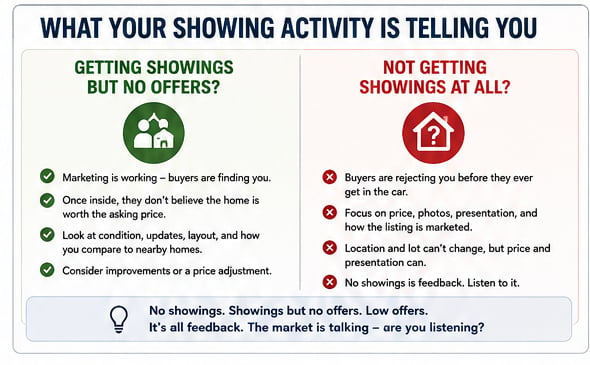
Start here: showings or no showings?
Before anything else, answer one question, because it splits the diagnosis in half.
If you're getting showings but no offers
The marketing is working. Buyers are finding you, and the photos, price range, and description are interesting enough to get them in the car.
Then something changes when they walk in.
That almost always means the buyer doesn't believe the house is worth the asking price once they compare its actual condition against the competition. Maybe the kitchen is more dated than the photos suggested. Maybe the bedrooms feel smaller than they looked. Maybe there's deferred maintenance. Maybe the updated house around the corner is only $10,000 more.
The answer isn't automatically a price cut — sometimes condition or presentation can close the gap. But repeated showings with no offers is feedback, and it should be treated that way.
If you're not getting showings at all
Different problem. Buyers are rejecting you before they ever get in the car, which points at price, photos, presentation, or how the listing is being marketed.
Some things can't be changed. Location can't move. The lot is the lot. But price and presentation can compensate for nearly everything you can't change.
No showings is feedback. Lots of showings and no offers is feedback. Offers well below asking is feedback. The market communicates constantly. The job is to listen before the listing goes stale.
Price: usually the first place I look
Price doesn't have to be wildly wrong to stall a house. Sometimes the gap is surprisingly small.
A seller wants $325,000. Buyers see a $310,000 to $315,000 property. To the seller that feels like a rounding error. To a buyer comparing four houses online with the same monthly payment, it decides which one gets the showing.
Buyers don't know what you paid. They don't know what you spent on the kitchen. They don't know what you need to net, and they don't care what your neighbor said the house was worth. They compare your property against everything else available at that payment.
The correct list price isn't the number that makes you happiest on listing day. It's the number that creates the most competition among buyers. Those are very different numbers.
Three pricing traps I see constantly here:
Pricing off a Zestimate. Automated values don't know your foundation, your school boundary, or what the inside actually looks like. I've sold homes well above their online estimate and watched homes priced to one sit for four months.
Pricing off 2022. That market is gone. Your comparable set is the last 90 days in your specific submarket — and Little Rock, North Little Rock, Sherwood, and Maumelle are behaving differently from each other right now.
Adding renovation cost to value. A $40,000 kitchen does not add $40,000 to the price. Buyers pay what a house is worth to them, not what you spent.
What this actually costs: a listing I lost
I had a seller who wanted $380,000. I ran the numbers and told them the house needed to be right around $350,000 to compete.
I brought them active competition. I brought them sold comparables. I showed them what buyers were actually choosing instead, and I did it more than once.
They wouldn't move. They were attached to the number.
The house sat. It eventually went under contract and the deal fell through, and by then it had been on the market long enough that buyers had started assuming something was wrong with it. Not because anything was wrong with it — because of the days on market.
That listing is with another agent now. It's priced at $330,000.
So think about what that decision actually cost. They turned down a $350,000 strategy and ended up $20,000 below it, after months of carrying costs, a failed contract, and a listing history that now works against them. And the house still has to overcome the stigma of having sat.
The $30,000 they refused to come down at the start became a $50,000 swing — and it's not over yet.
I'm not telling you that to be harsh about a client. I'm telling you because that's the most expensive version of the mistake I'm describing, and it started with a price that was only about 8% too high.
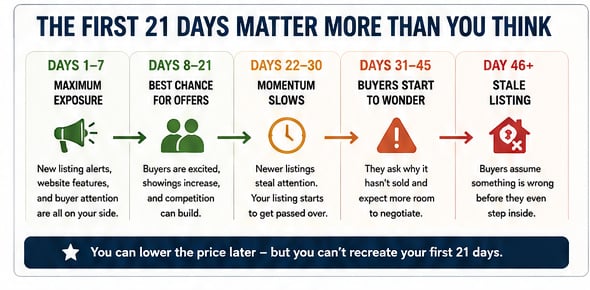
Your first two weeks are worth more than you think
A new listing has something you can't buy back later: novelty.
When your house hits the market, every buyer already searching that price range sees it. Their agents see it. The portals feature it as new. People with saved searches get alerts.
That's your best exposure, and it happens once.
If the house is positioned right, that attention creates showings, offers, and competition. If it's overpriced, buyers do something much simpler — they skip it.
Then a week passes. Then another. At day 30, buyers wonder why it hasn't sold. At day 45, they assume there's room to negotiate. At day 60, some assume something is wrong with the house before they've ever walked through the door.
That's why I don't like listing high with the plan to "come down later." You can always come down. You cannot recreate your first week on the market.
Your online presentation is your first showing
Most buyers decide whether your house deserves an in-person visit while looking at a phone.
Your first photo matters more than any other single element of the listing — on every major portal, that one image determines whether anyone clicks. If it isn't your strongest exterior or best interior space, fix it today.
Beyond that: professional photography, photo order, lighting, decluttering, and the description all do work. If the first ten images make the house look dark, cramped, cluttered, or dated, buyers never schedule. You don't get to explain that it looks better in person to someone who never comes.
The online presentation has exactly one job: get the buyer through the door. Then the house has to do its job.
Professional photos on a $250,000 listing cost a few hundred dollars. There's no version of that math where skipping it makes sense.
Condition matters more when buyers have choices
When inventory is tight, buyers tolerate more. When there are a dozen similar homes, they get picky.
That doesn't mean renovating before you list. I wouldn't tell anyone to spend $40,000 on a kitchen to put a house on the market. But buyers notice the accumulation: worn carpet, scuffed walls, burned-out bulbs, overgrown landscaping, cluttered rooms, strong odors, damaged trim, a dark house, deferred maintenance.
No single one of those kills a sale. Together they change how the house feels.
Buyers don't walk through with a spreadsheet adding up flaws. They form an impression. A clean, bright, uncluttered house feels maintained. A neglected house feels expensive — and that emotional difference shows up in the offer, if one comes at all.
The cheap fixes that return the most: fresh neutral paint, replacing worn carpet, brightening every fixture and opening every blind, removing about a third of your furniture, and cleaning up the yard. That's a couple thousand dollars in most homes, and it moves the needle further than a price cut of the same amount.
The cause nobody suspects: showing access
This one is invisible to most sellers and it kills more deals than people realize.
If buyers need 24 hours notice, if showings are limited to certain days, if you're home during tours, if there's a dog to handle, or if the lockbox situation is complicated — agents schedule around you. Not out of spite. They have a buyer in town for two days and eight houses to see, and yours is the hard one.
Being present during showings is a bigger problem than sellers believe. Buyers won't open closets, won't talk honestly to their agent, and won't linger. And how long a buyer stays in a house correlates strongly with whether they write.
Go as close to unrestricted access as you can stand, and leave for every showing. If you're serious about selling, be inconvenienced for three weeks.
The metro is not one market
A mistake sellers make is treating "Central Arkansas" as a single housing market. It isn't.
Days to go under contract for homes that sold: Little Rock about 21 days, North Little Rock about 16, Sherwood about 10, Maumelle about 8.
Days that currently active listings have been sitting: Little Rock about 60, North Little Rock 57, Maumelle 52, Sherwood 39.
If I'm pricing in Maumelle, I'm not using North Little Rock expectations. And even inside Little Rock, West Little Rock, Midtown, Southwest, the Heights, Hillcrest, and Chenal behave differently.
Then add price range. A $175,000 house and a $750,000 house don't share a buyer pool. Pricing off a citywide median isn't enough — your house has to be compared against the homes buyers are actually considering instead of yours.
Should you reduce the price?
Possibly — but a reduction has to be strategic.
I don't like cutting $2,000 just so the portals show a price change. The reduction needs to move you into a different competitive position. If you're at $329,900 and the market is telling you $310,000, going to $327,500 changes nothing. You still have the same problem, and now buyers know more cuts are coming.
The question isn't "how little can we reduce?" It's "where does this house become compelling compared to everything else the buyer can purchase?"
Sometimes that's a price adjustment. Sometimes it's improving condition. Sometimes it's closing costs or a rate buydown. Often it's a combination. The goal isn't to punish the seller — it's to get the market to respond.
Should you offer closing costs instead of cutting price?
Often, yes — and this is underused.
With rates where they are, cash and monthly payment dominate buyer decisions. A $10,000 price reduction may not change a buyer's payment as much as you'd expect. That same $10,000 applied to allowable closing costs or a rate buydown can solve a much bigger problem for them.
That's especially true with first-time buyers who can handle the payment but are trying to preserve cash.
You still have to watch your net. But negotiation isn't only about price — it's about finding the structure that makes the deal work for both sides.
Should you take it off the market and relist?
Only if something meaningful changes.
Pulling a listing for a few weeks doesn't erase anything — buyers and agents can still see the property history. So the real question is what you're changing before it comes back.
New price? Improved condition? Replaced photography? Corrected marketing? Repairs completed? Repositioned?
If the answer is no, relisting just gives you the same house with the same problem and a newer date. A reset only works when something was actually reset.
How long should you wait before changing something?
There's no universal number, because every price range and neighborhood moves differently. Compare yourself to the normal selling window for your market.
Under 21 days in Little Rock: you're still inside the normal window. Watch your showing count and use the diagnostic above.
21 to 45 days: time for a real conversation, not wait-and-see. Pull what's closed in the last 30 days, redo photos if there's any doubt, and make a decisive adjustment if the data says so.
45 to 90 days: you're in the pile. Buyers see your days-on-market and negotiate accordingly. Fix the underlying problem — at this point price cuts alone often just confirm their suspicion.
Over 90 days: consider withdrawing, fixing the real issues, and relaunching properly.
If similar homes go under contract in 10 to 20 days and you're at 30 with no meaningful activity, don't wait another month because someone says the right buyer will come along. Look at the data again. What listed after you? What went pending? What sold? What reduced? What did buyers choose instead?
The market doesn't care how long you want to wait. It keeps moving around you.
The biggest mistake sellers make
Becoming emotionally committed to the original list price.
The original list price was an opinion. The market response is evidence. Those aren't the same thing.
Maybe the price was right on day one and new competition changed it. Maybe the comp everyone leaned on was unusually strong. Maybe the condition difference was bigger than anyone accounted for. Maybe buyers value something differently than expected.
There's nothing wrong with adjusting when new information arrives. The expensive mistake is ignoring the information because changing course feels like admitting someone was wrong.
The goal was never to prove the list price was right. The goal is to sell the house for the strongest possible net.
Sellers in Little Rock closed at about 97.1% of list in July. In North Little Rock, 94.9%. That's the normal gap. If you're being asked to come down far more than that, the problem was your starting number.
Chasing the market down is the most expensive way to sell a house.
The honest bottom line
If your house isn't selling in Little Rock, don't automatically blame the market. Homes here are going under contract in 8 to 21 days depending on where you are, and sellers are getting 95 to 97 cents on the dollar.
But active listings are sitting for 39 to 60 days. That gap is the story. This market rewards homes that are priced, prepared, and presented correctly, and punishes the ones that miss.
Something specific is causing buyers to choose someone else — price, photos, condition, access, or positioning. Every one of them is fixable.
The hard part isn't the fix. It's being willing to hear which one it is.
Your best opportunity to sell is while buyers still see your house as something to compete for, not something to negotiate against.
Already listed and not getting the activity you expected? Or thinking about selling and want to avoid the 60-day pile? Send me the address. I'll pull recent sales, current competition, pending activity, days on market, and price history for your specific neighborhood and show you exactly what buyers are responding to right now.
Call or text 501-988-3758 or email [email protected]. No pressure, no pitch.
Zach Dunivan is a licensed Arkansas Realtor® with Coldwell Banker RPM Group and the founder of Dunivan Real Estate, serving Little Rock, North Little Rock, Maumelle, Conway, Benton, Bryant, Sherwood, and Central Arkansas. If your home is currently listed with another brokerage, this article is not a solicitation of that listing.
Real Advice. No Pressure. No Fluff.