🎥 Prefer to watch instead? I walk through all of these programs on video — watch "Arkansas Down Payment Assistance: How to Get Up to $15,000" here: https://youtu.be/a-6OKGib51s. Subscribe to Arkansas Real Estate Advisor for weekly Central Arkansas breakdowns.
Yes — Arkansas homebuyers can get between $1,000 and $15,000 toward their down payment and closing costs through the Arkansas Development Finance Authority. But there's a detail that gets left out of most conversations: that assistance is generally a second mortgage repaid over ten years, not a grant that disappears.
That doesn't make it a bad program. For the right buyer it solves the single biggest obstacle to homeownership. It just means you need to understand what you're actually signing.
I'm Zach Dunivan, a Realtor here in Central Arkansas. The most common thing I hear from people who want to buy is some version of: "I can afford the payment. I just don't have enough saved to get to closing."
That's exactly the problem these programs exist to solve — and there are more of them than most buyers realize.
Program details current as of September 2026. Rates, income limits, and funding availability change. Confirm everything with a participating lender before you rely on it.
How much assistance can Arkansas buyers actually get?
ADFA currently offers qualifying buyers between $1,000 and $15,000 in down payment and closing cost assistance. That money can go toward your down payment, your closing costs, and certain expenses you already paid out of pocket before closing.
The amount you qualify for depends on the mortgage program, lender approval, purchase price, income, credit profile, and the rest of your financial picture. "Up to $15,000" does not mean every buyer receives $15,000 — it means that's the current ceiling for borrowers who qualify at the top of the range.
Is the $15,000 free money?
No, and this is the most important thing to understand before you use it.
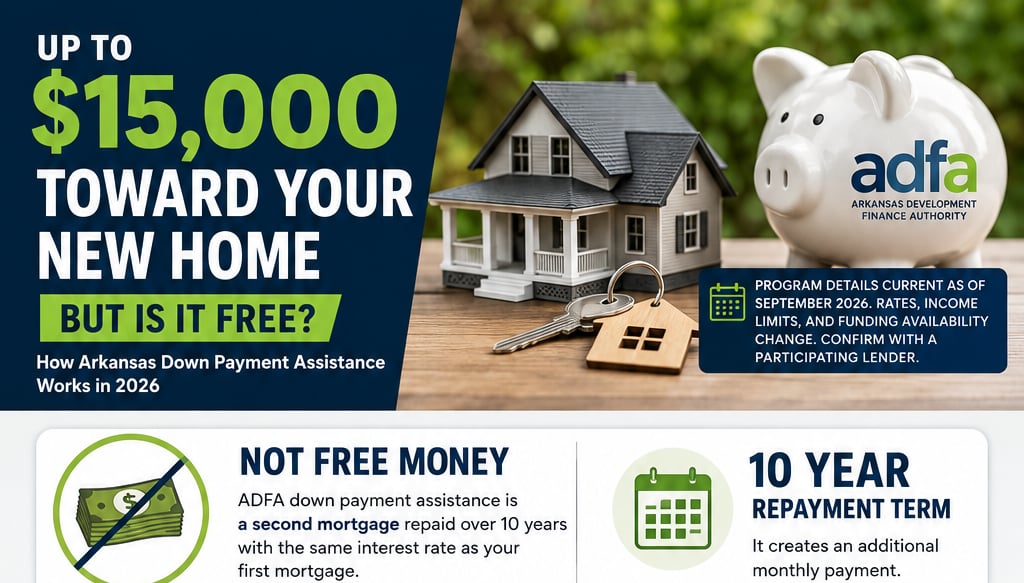
ADFA's down payment assistance is structured as a second mortgage with a ten-year repayment term, carrying the same interest rate as your first mortgage. If you take the assistance, you are borrowing that money, and it creates an additional monthly payment.
For a buyer who could comfortably handle the payment but is two years from saving the cash, that trade is often absolutely worth it. For a buyer who already has savings, it may not be. I don't treat down payment assistance as automatically good or bad — it's a tool, and the only question that matters is whether it fits your situation.
But there are two forgivable programs most buyers never hear about, and if you qualify for either one, it changes the math entirely. I'll get to those below.
The part nobody talks about: the interest rate
Everybody focuses on the $15,000. I want to spend a minute on something worth considerably more.
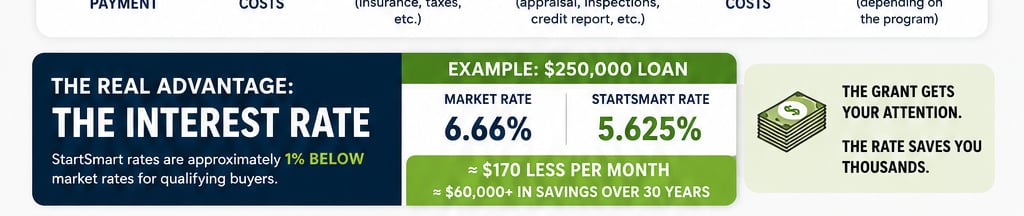
ADFA's StartSmart program uses tax-exempt mortgage revenue bonds to offer 30-year fixed rates approximately one percent below prevailing market rates. As of late August 2026, ADFA was listing 5.625% for its StartSmart government mortgage program and 5.875% for its Freddie Mac conventional program for qualifying borrowers below 80% of area median income. Freddie Mac's reported national average 30-year fixed rate on August 27, 2026 was 6.66%.
Those aren't a perfect apples-to-apples comparison — Freddie Mac's figure samples a specific conventional market and ADFA programs have their own qualifications and structures. But run the difference anyway.
On a $250,000 loan, the gap between 6.66% and 5.625% is roughly $170 a month. Over thirty years, that's more than $60,000.
That's not a one-time credit. It's a lower payment every month for as long as you own the house. The grant money is what gets attention; the rate is where the actual money is.
What is StartSmart, and who qualifies?
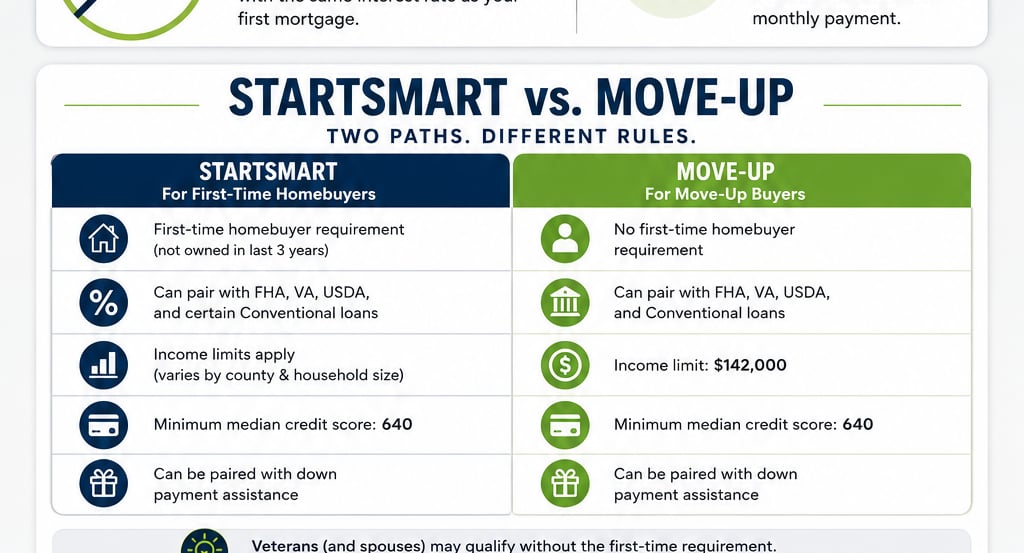
StartSmart is ADFA's first-time homebuyer mortgage program. It works with FHA, VA, Rural Development, and certain Freddie Mac conventional financing, and it can be paired with the down payment assistance.
Who counts as a first-time buyer? Generally, someone who hasn't owned their principal residence in the previous three years. You don't have to be someone who has never owned property — a buyer who sold a home four years ago and has been renting since may qualify again.
There are also exceptions worth knowing:
Veterans and spouses of veterans with proper documentation may not have to meet the first-time-buyer requirement at all.
Targeted counties. The first-time-buyer requirement is waived when purchasing in certain federally targeted Arkansas counties — and this matters enormously in Central Arkansas, because the lines aren't where you'd expect. Pulaski, Saline, and Lonoke Counties are generally not on the targeted list, so a StartSmart buyer there would normally need to meet the first-time requirement unless another exception applies. Conway County and White County are among the targeted counties.
That means two buyers purchasing homes thirty or forty minutes apart can qualify under completely different rules. If you're shopping across county lines in Central Arkansas — and a lot of people are — ask your lender specifically how the property's county affects your eligibility.
Credit score: current ADFA guidelines generally require a minimum median score of 640. That's separate from the loan program's own minimum. FHA might technically allow lower, but if you want ADFA assistance, you also have to satisfy ADFA. This is why I tell buyers not to plan their purchase around what they read about FHA minimums — your loan program, lender, assistance program, and debt-to-income ratio all have to work together.
Do you have to be a first-time buyer?
Not necessarily, and this is a misconception worth clearing up.
ADFA's Move-Up program has no first-time-homebuyer requirement. Someone who currently owns a home, or owned one recently, may still qualify.
Move-Up borrowers must use the property as a primary residence, have a minimum credit score of 640, and have qualifying income no higher than $142,000. It pairs with FHA, VA, conventional, and Rural Development financing, and qualifying borrowers can combine it with ADFA down payment assistance.
That income ceiling is high enough that a lot of people who assume they earn too much for assistance actually don't.
The forgivable programs most buyers never hear about
Here's where it's worth pushing your lender for specifics, because these two are structurally better than the repayable DPA if you qualify.
The Arkansas Dream Down Payment Initiative (ADDI) is a separate program for qualifying low-income buyers, structured as a forgivable soft second mortgage worth up to 10% of the purchase price, capped at $10,000. No monthly payment, and the balance is forgiven over time if you stay in the home.
The City of Little Rock First-Time Homebuyers Program offers up to 6% of the purchase price, capped at $5,000, for income-eligible first-time buyers purchasing inside Little Rock city limits. It's a forgivable second mortgage, forgiven in equal monthly installments over 60 months — stay five years and you never repay a dollar.
The city program requires that you haven't owned residential property in the last three years, that household income generally falls at or below 80% of area median income, that you complete an approved homebuyer counseling course, that the home becomes your primary residence, and that all repairs are completed before assistance is approved. No cash back at closing. Your lender also has to have a physical presence in Arkansas — which quietly disqualifies a lot of online lenders.
These programs can stack. A below-market StartSmart first mortgage, ADFA down payment assistance, and city assistance is a legitimate combination. I've watched buyers walk into closing having brought a fraction of what they expected to need.
Ask about ADDI by name. Not every loan officer raises it unprompted.
Can assistance cover everything you need to close?
Sometimes it covers a large portion. But don't assume you can buy a house with literally zero dollars available.
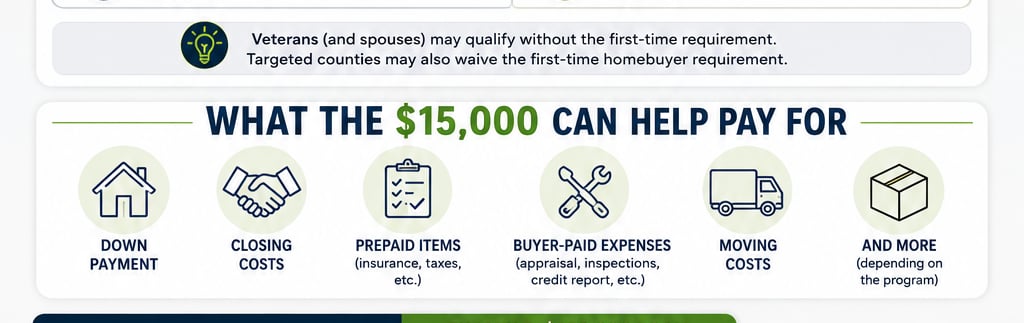
You'll likely need money before closing for earnest money, inspections, an appraisal depending on how your lender handles it, insurance, deposits, and moving costs. Some of that may be covered or credited within the transaction — but the timing matters, and money is often required before any assistance shows up.
I also don't like seeing anyone close on a house with nothing left in the bank. Homeownership comes with surprises, and an HVAC system does not care that you just closed. Neither does a water heater or an insurance deductible.
Getting into the house is half the conversation. Staying there comfortably is the other half.
Can the seller still pay closing costs if I use assistance?
Potentially, yes. Down payment assistance and seller concessions are two different tools, and depending on the loan program you may be able to use both.
This is especially relevant in the current Central Arkansas market. As I broke down recently, Little Rock, North Little Rock, Sherwood, and Maumelle are all still technically seller's markets based on months of inventory — but that doesn't mean sellers hold unlimited leverage. Homes that have been sitting longer than their submarket's median are where buyers have real room to negotiate.
And for many buyers, asking for seller-paid closing costs or a rate buydown does more good than an equivalent price reduction. If assistance lowers the cash you bring and concessions lower your closing expenses on top of that, the combination can change your entire purchase math.
So what's the catch?
There's no universal free-money program, and every one of these has conditions:
You have to qualify — credit requirements, income limits, and program-specific rules all apply. StartSmart generally requires first-time-buyer status unless an exception applies. The ADFA assistance is repayable and adds a second monthly obligation. You have to use a participating lender, and not every lender originates these loans. And funding is finite — these programs run on allocated dollars, and when a cycle's funding runs out, applications wait.
None of that makes the programs unattractive. It just means you compare the whole financial picture rather than chasing a headline number. Have your lender run a genuine side-by-side against a standard FHA or conventional loan, because ADFA loans carry their own mortgage insurance structures and fee rules. Usually ADFA wins. Not always.
I would much rather someone spend an extra hour understanding both loans than pick a program because somebody told them they could get $15,000.
Should you use assistance, or save longer first?
It depends on why you're waiting.
If you can comfortably afford the monthly payment, your employment is stable, you'll still have some reserves after closing, and the only thing standing between you and a house is the final cash to close — assistance is worth serious consideration.
If your income is unstable, your debt load is already high, or the payment would leave you stretched every month, then buying sooner isn't the right goal. The purpose isn't getting into a house at any cost. It's sustainable homeownership.
But there's a real cost to waiting, too. If you're renting for three more years while you save toward a traditional down payment, those rent payments are still leaving your account every month. For someone who plans to stay in the area and whose numbers otherwise work, assistance can move the timeline forward substantially.
What to do this week
Call a lender who actually originates ADFA loans and ask directly whether they do StartSmart and Move-Up, and whether you'd qualify. If they hesitate or don't know the programs, call someone else — that's not a knock on them, it's just that not every lender works in this space.
Ask about ADDI specifically, not just DPA. Ask how your property's county affects your eligibility. If you're buying inside Little Rock city limits, have your lender contact the city's Housing and Neighborhood Programs department.
And get the homebuyer education course done early. It's required for several of these programs and it becomes the bottleneck when people leave it until they're under contract.
The bottom line
Yes, Arkansas buyers can get up to $15,000 through ADFA. No, it isn't automatically free money — it's generally a ten-year second mortgage, and you still have to qualify for the first mortgage.
But StartSmart may give first-time buyers both assistance and a rate about a point below market. Move-Up opens the door for people who've owned before. ADDI and the City of Little Rock program are genuinely forgivable if you qualify. And they can stack.
The reason I push on this is simple. The most common thing keeping people renting in Central Arkansas isn't income and it isn't credit — it's the belief that they need a pile of cash they don't have.
The gap between renting and owning here is usually smaller than people think. It costs one phone call to find out whether you're closer than you assumed.
Thinking about buying in Little Rock, North Little Rock, Sherwood, Maumelle, Conway, Benton, Bryant, Jacksonville, or Cabot? Call or text me at 501-988-3758 or email [email protected]. I'll help you on the purchase side and connect you with a lender who works with these programs, so you can see your actual numbers before you decide anything.
Buying your first home? I run a free first-time home buyer class that walks through the whole process.
Zach Dunivan is a licensed Arkansas Realtor® with Coldwell Banker RPM Group and the founder of Dunivan Real Estate, serving Little Rock, North Little Rock, Maumelle, Conway, Benton, Bryant, Sherwood, and Central Arkansas. This article is informational only and is not lending advice. Program terms, rates, and funding availability change — confirm all details with a participating lender and the administering agency.
Real Advice. No Pressure. No Fluff.