🎥 Prefer to watch instead? I break this down on video — watch "The Fed Just Raised Rates. What It Actually Means for Little Rock" here: https://youtu.be/QoQHsT7Obu4. Subscribe to Arkansas Real Estate Advisor for weekly Central Arkansas breakdowns.
On Wednesday, September 16, the Federal Reserve raised its benchmark rate a quarter point to 3.75%–4.00% — the first hike since July 2023. The vote was unanimous, 12-0.
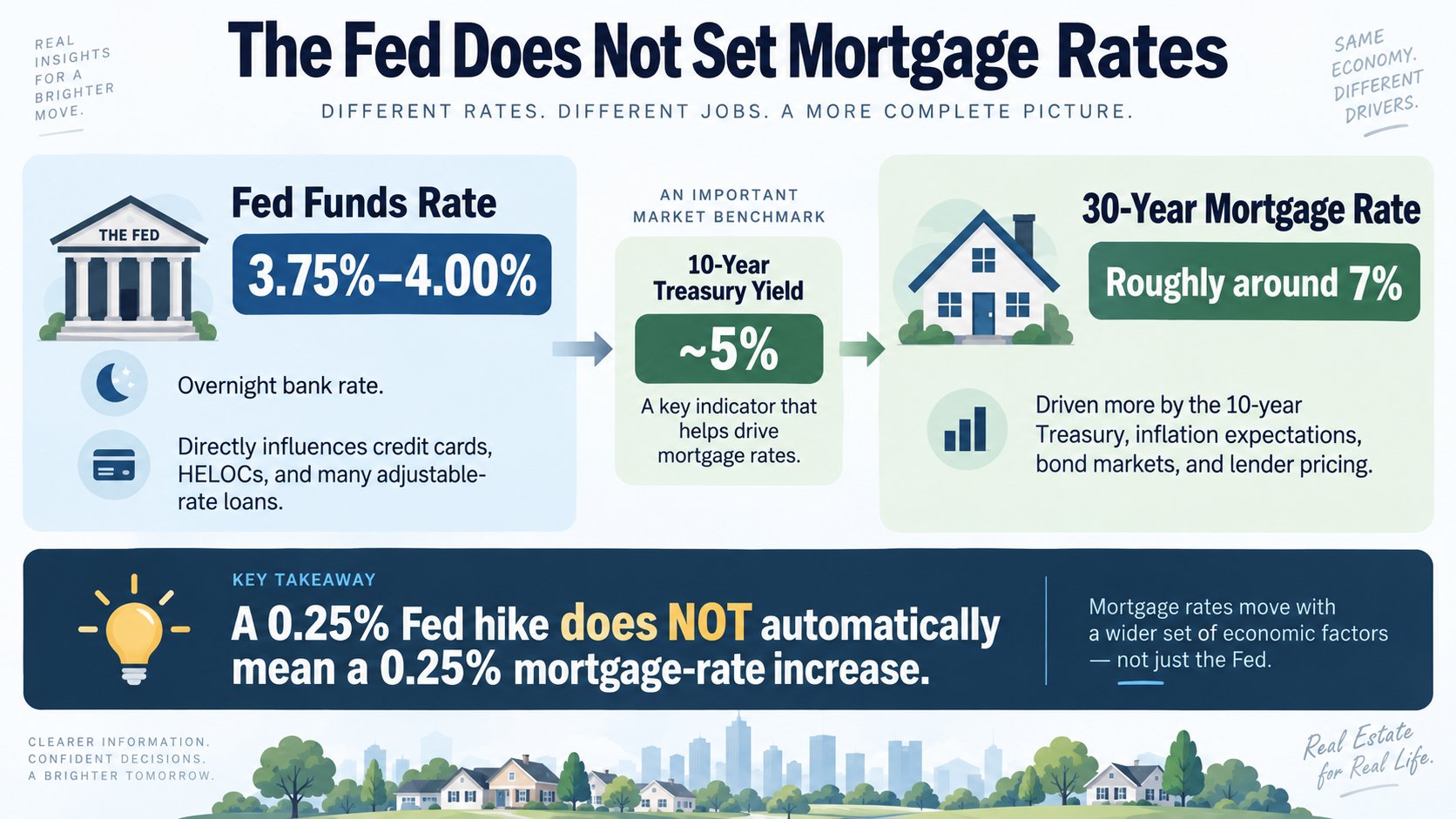
Here's what almost every headline is getting wrong: that does not mean your mortgage rate automatically rose by the same quarter point. The Fed does not set mortgage rates.
And here's the part most national coverage is missing. I pulled live rate sheets the day of the decision. A state program is still quoting 5.75% while conventional financing quoted locally that same day sits at 6.99%.
That's a 1.24-percentage-point difference, worth more than $200 a month on a $250,000 loan.
I'm Zach Dunivan, a Realtor here in Central Arkansas. Let me walk through what actually happened, what the real numbers look like locally, and what I'd do about it.
Written September 17, 2026, the day after the decision.
What the Fed actually did
The FOMC raised the federal funds rate 25 basis points to 3.75%–4.00%, reversing the cutting cycle markets had gotten comfortable with.
The reason is inflation. Consumer prices rose 3.4% in August year over year, and the monthly increase quadrupled from July to 0.4%. Inflation has now run above the Fed's 2% target for more than five years.
The projections matter as much as the hike. The dot plot showed 16 of 18 participants expect at least one more increase this year, with four seeing two as possible. The median projection puts the federal funds rate at 4.1% for 2026, 4.1% for 2027, and 3.9% for 2028.
Read that again if you've been waiting for rates to fall before you buy. The Fed's median projection does not show the policy rate declining until 2028.
The Fed does not set mortgage rates
The federal funds rate is what banks charge each other for overnight lending. It directly drives credit cards, home equity lines, and adjustable-rate mortgages after their fixed period ends. It does not set the 30-year fixed.
Mortgage rates track the 10-year Treasury yield, which moves on inflation expectations and long-term economic outlook — not on this afternoon's vote.
If you want proof, look at 2025. The Fed was cutting. Mortgage rates went up.
This week, the 10-year Treasury had already pushed above 5% before the meeting — its highest since 2007 — and remained volatile around that level afterward. That is the number I'd watch far more closely than the fed funds rate if you're trying to understand where mortgage rates are heading.
There's also a case that a hike helps the long end of the curve. Investors buying 30-year debt care whether inflation erodes their return, and a central bank willing to raise rates is a central bank defending against that. a Fed hike doesn't automatically translate into higher mortgage rates — and sometimes coincides with the opposite.
What Arkansas lenders are actually quoting
National averages are useful context. Local quotes are what you'll actually pay.
Freddie Mac's weekly survey put the 30-year fixed at 6.76% as of September 10, the highest reading in more than 14 months. Mortgage News Daily's faster-moving daily tracker had the conventional 30-year at 7.12% this week.
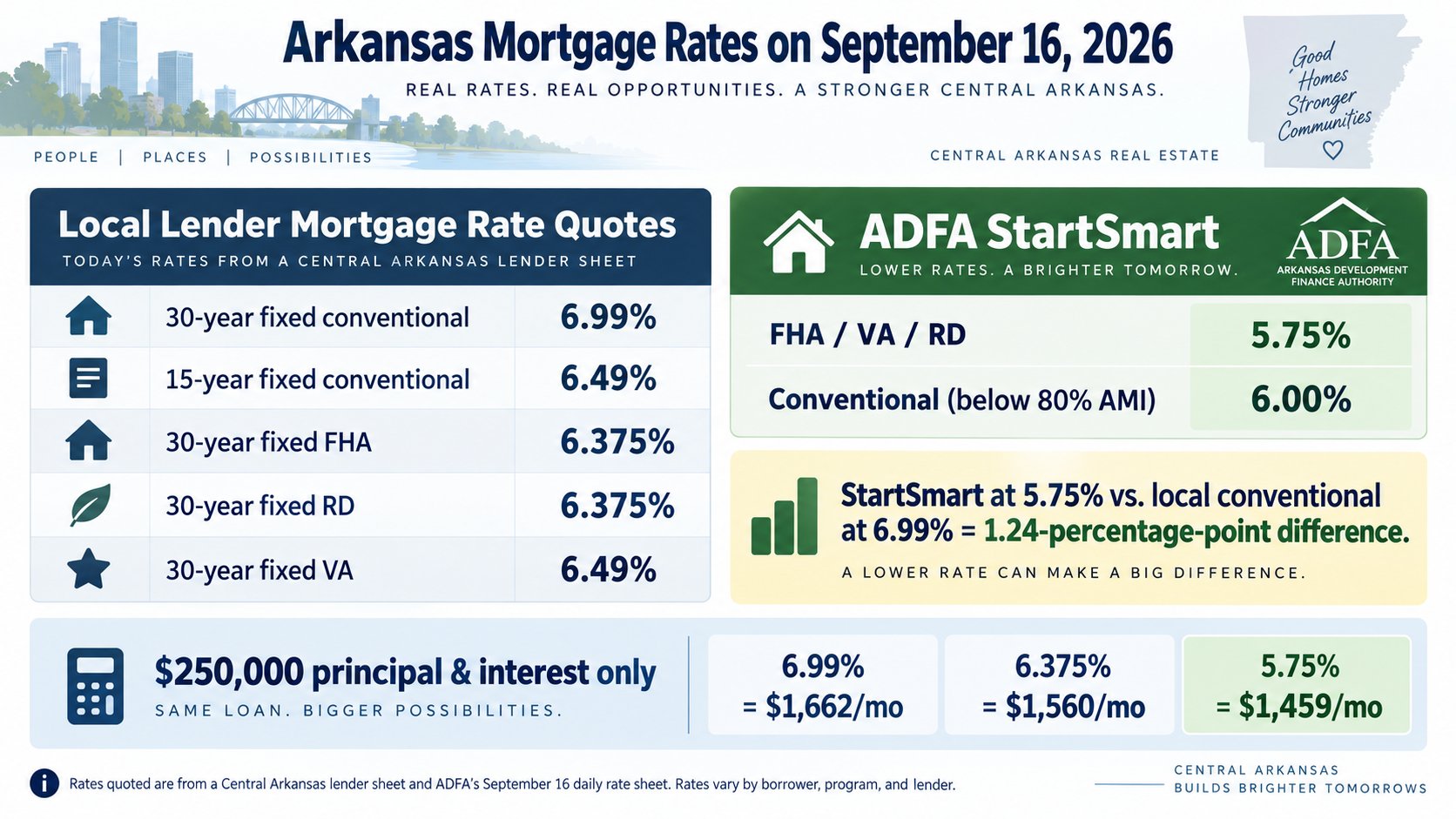
Here's what a Central Arkansas lender I work with was quoting on September 16, the day of the decision, with 1% origination across the board:
Loan type | Rate |
|---|---|
30-year fixed conventional | 6.99% |
15-year fixed conventional | 6.49% |
30-year fixed FHA | 6.375% |
30-year fixed RD | 6.375% |
30-year fixed VA | 6.49% |
Two things worth noting. Conventional at 6.99% is above the Freddie Mac survey average — which is normal. Freddie Mac is a weekly national benchmark based on a defined borrower profile, so it won't necessarily match a live local lender rate sheet. And FHA and VA are meaningfully cheaper than conventional right now, 50 to 60 basis points. If you've been assuming conventional is always the better loan, that's worth checking.
The number nobody is reporting
Now here's the part that made me want to write this today.
Same day. Same state. Here is ADFA's September 16 daily rate sheet, which the agency distributes directly to participating lenders rather than posting publicly:
ADFA program | Rate |
|---|---|
StartSmart — FHA, VA, RD | 5.75% |
StartSmart — conventional (below 80% AMI) | 6.00% |
Move-Up — FHA, VA, RD | 6.875% |
Move-Up — conventional (below 80% AMI) | 6.875% |
Move-Up — conventional (above 80% AMI) | 7.00% |
StartSmart held. At 5.75% against the 6.99% conventional quote I received locally that same day, that's 1.24 points below market — wider than the "approximately 1% below market" ADFA typically advertises.
The Fed raised rates. StartSmart didn't move.
What that's worth on a $250,000 loan, principal and interest only:
- Conventional at 6.99% — $1,662/month
- FHA at 6.375% — $1,560/month
- StartSmart at 5.75% — $1,459/month
That's $203 a month below conventional. Over thirty years, roughly $73,000. Even against standard FHA, StartSmart saves about $101 a month.
On a $200,000 loan the gap is $162/month. On $300,000 it's $243.
StartSmart is a first-time buyer program, which in Arkansas means you haven't owned your principal residence in the past three years — and there are exceptions for veterans and for certain targeted counties. It carries income and purchase price limits, and it can be paired with ADFA down payment assistance of $1,000 to $15,000.
One deadline to know: ADFA's sheet specifies the compliance package must be received within 5 business days. These programs are not a "think about it next month" proposition.
Move-Up, for buyers who've owned before, is currently quoting at or slightly above the standard market. So the program advantage right now is concentrated in StartSmart.
What this means for Central Arkansas specifically
National rate news lands on top of a local market, and ours just shifted.
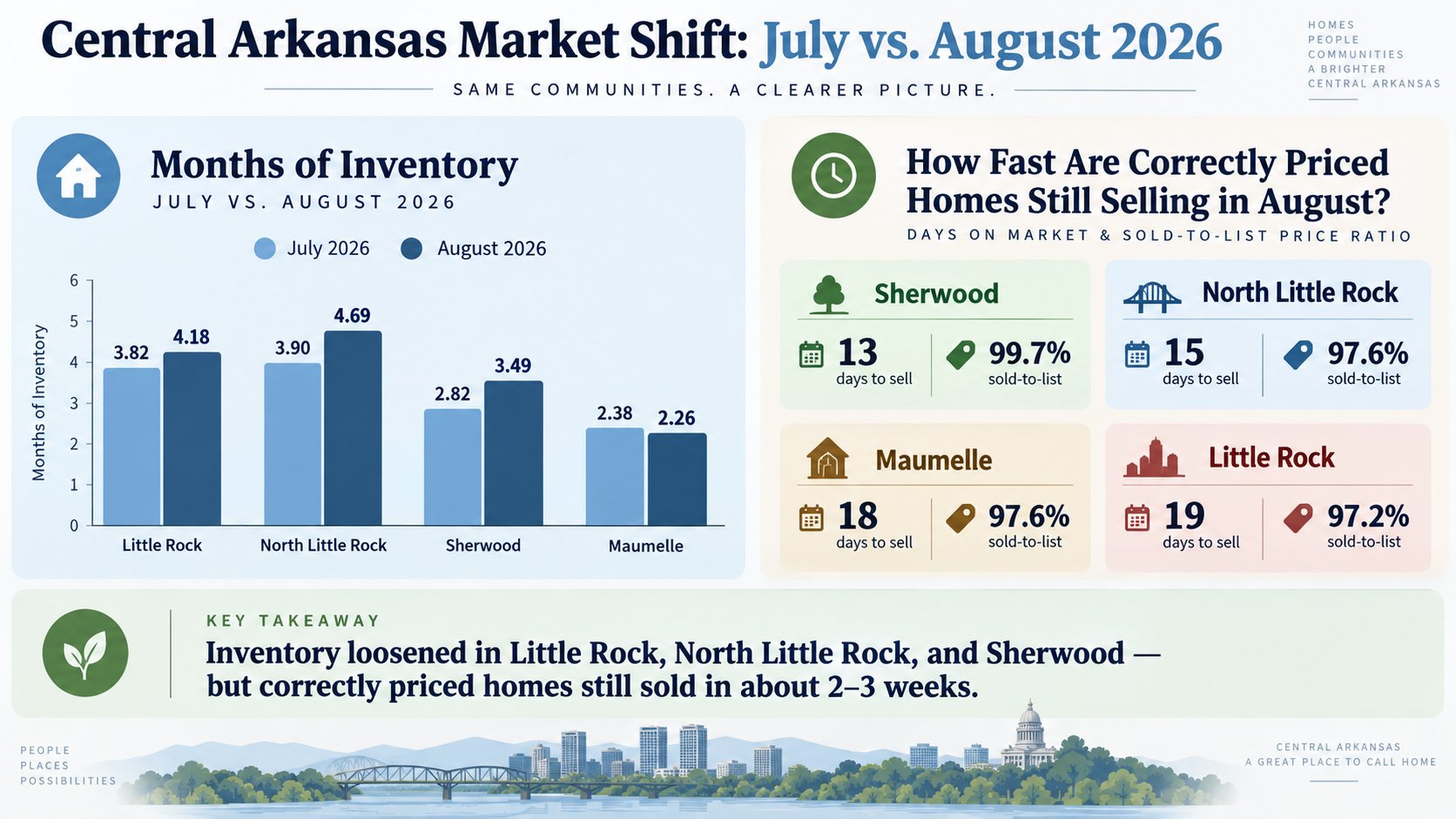
Comparing August to July in the RPR data, months of inventory moved:
Market | July | August |
|---|---|---|
Little Rock | 3.82 | 4.18 |
North Little Rock | 3.90 | 4.69 |
Sherwood | 2.82 | 3.49 |
Maumelle | 2.38 | 2.26 |
Little Rock and North Little Rock both crossed above 4.0 months in August. Using the common four-to-six-month rule of thumb, they're no longer seller's markets — they're balanced. North Little Rock inventory is up 24.4% year over year. Sherwood jumped 24.6% in a single month.
That's a real change, and I'm reporting it because it happened, not because it fits a narrative. Two weeks ago I wrote that Central Arkansas was still firmly a seller's market. The August numbers moved.
But look at what didn't change:
Market | Days to sell | Sold-to-list |
|---|---|---|
Sherwood | 13 | 99.7% |
North Little Rock | 15 | 97.6% |
Maumelle | 18 | 97.6% |
Little Rock | 19 | 97.2% |
Homes that are priced right are still going under contract in about two to three weeks, at 97 to 99.7 cents on the dollar. Sherwood sellers got 99.7% of asking in August.
Meanwhile active listings in both Little Rock and North Little Rock have been sitting a median of 60 days.
So the split I've been describing is still the whole story. Correctly priced homes move fast. Overpriced homes pile up. What's changed is that the pile is getting bigger — and now buyers are financing it at 7%.
Central Arkansas data from RPR, August 2026.
What I'm actually seeing this week
Two real examples from my own business.
I had a buyer lock their rate on Tuesday, the day before the announcement, specifically in anticipation of it. That turned out to be the right call — not because I can predict the Fed, but because they had a rate they could live with and a house they wanted, and they chose certainty over a guess.
I have another client whose house is listed and who called asking what to do now. That's the harder question, and my answer was this: nothing about Wednesday changes what a correctly priced house does in Central Arkansas. Sherwood sellers got 99.7% of ask last month. What it changes is that your buyer is now more payment-sensitive than they were in July — which makes pricing precision and concession strategy more important, not less.
Buydowns are the tool for this market
When financing gets more expensive, the seller concession conversation should shift from price to rate.
Here's the structure, as another local lender laid it out for me this week. These work on conventional, FHA, RD, VA, and in-house loans:
The 1/0 buydown drops your rate 1% for the first 12 months, then moves to the locked rate in year two. The 1/1 holds that 1% reduction for a full 24 months before reverting in year three. The 2/1 is the one I see most often: 2% lower in year one, 1% lower in year two, locked rate from year three forward. And the 3/2/1 stretches it further — 3% lower the first year, 2% the second, 1% the third, locked rate from year four.
What any of them costs depends on which structure you choose, the locked rate, and the loan amount.
Why this matters more than a price cut: at roughly 7%, a $10,000 price reduction changes a payment by about $66 a month. That same $10,000 applied to a temporary buydown can drop the payment by several hundred a month in the early years — which is exactly when most buyers are stretched.
If you're buying a home that's been sitting past its submarket's median, ask about a buydown before you ask for a price cut. Sellers who won't move on price will often move on this.
If you're buying
Your loan didn't change Wednesday. The decision in front of you is the same one it was Tuesday — does the payment work, and are you staying long enough for it to make sense.
Check whether you qualify for StartSmart before you do anything else. For a qualifying Arkansas buyer, a 5.75% StartSmart rate in a roughly 7% market may be one of the most valuable financing opportunities available right now — and most people have never heard of it. Ask your lender about it by name, because it doesn't always come up unprompted.
Compare FHA and VA against conventional. The spread between them is meaningful right now, and if you've been assuming conventional is automatically the better loan, that assumption is worth testing against an actual quote.
Ask about a buydown before you ask for a price cut, particularly on a home that's been sitting past its submarket's median. Sellers who won't move on price will frequently move on rate.
And be honest with yourself about the waiting strategy. The argument for waiting was always that rates would fall. Most Fed officials now project at least one more increase this year, and the median policy rate doesn't decline until 2028. If you're renting while you wait, that timeline got longer — and the rent doesn't come back.
If you're selling
Correctly priced homes are still selling in two to three weeks. Nothing about Wednesday changed that, and Sherwood sellers got 99.7% of asking price last month.
But inventory rose in three of four submarkets, and your buyer is more payment-sensitive than they were in July. The gap between a well-priced house and an overpriced one widens every time financing gets more expensive, which makes pricing precision more important now, not less.
Consider offering a buydown instead of a price reduction. If a buyer is on the edge of qualifying, money applied to their rate often does more for them than the same money off your price — and it frequently costs you less than a full reduction would.
And if you've already been sitting, this isn't the week to wait and see. Active listings in Little Rock and North Little Rock have been on the market a median of 60 days while homes that sold took 19 and 15 days. Every week of hesitation now happens in a slightly tighter financing environment than the week before.
What I'd watch from here
Not the Fed. The 10-year Treasury. That's what your mortgage rate follows.
Specifically: the next CPI report, whether that 3.4% inflation reading keeps climbing, and whether the 10-year holds below 5%.
If inflation cools, the 10-year falls and mortgage rates follow regardless of what the Fed does with the overnight rate. If inflation keeps running hot, the opposite — and another hike would be a symptom of that problem, not the cause of higher mortgage rates.
The honest bottom line
The Fed raised rates. That does not mean your mortgage rate automatically rose by the same quarter point. Those are two different things, and the headlines are blurring them.
Central Arkansas inventory loosened in August, and Little Rock and North Little Rock are now technically balanced markets rather than seller's markets. But homes that are priced right still go under contract in two to three weeks at 97 cents on the dollar or better.
And the most useful thing in this entire article is that a state program was quoting 5.75% on September 16 while conventional financing quoted locally that same day sat at 6.99%.
For two years the assumption was that rates were headed down and waiting would be rewarded. The Fed just said otherwise. If that was your plan, this is a reasonable week to reexamine it.
Want to know what this means for your situation? Call or text me at 501-988-3758 or email [email protected]. Tell me whether you're buying or selling and where, and I'll give you a straight read and connect you with a lender who can quote your actual numbers. No pressure, no pitch.
Buying your first home? I run a free first-time home buyer class that covers financing, ADFA programs, and the whole process.
Rates quoted are as of September 16, 2026, sourced from a Central Arkansas lender rate sheet and ADFA's daily rate sheet, and include 1% origination. Rates change daily and vary by credit score, down payment, loan program, points, and property. This is not a rate quote or an offer to lend. Get a current quote from a licensed lender before making any decision.
Zach Dunivan is a licensed Arkansas Realtor® with Coldwell Banker RPM Group and the founder of Dunivan Real Estate, serving Little Rock, North Little Rock, Maumelle, Conway, Benton, Bryant, Sherwood, and Central Arkansas. This article is informational only and is not financial, lending, or investment advice.
Real Advice. No Pressure. No Fluff.