🎥 Prefer to watch instead? I break this down on video — watch "What Can a Seller Pay For When You Buy in Arkansas?" here: [video coming soon). Subscribe to Arkansas Real Estate Advisor for weekly Central Arkansas breakdowns.
With 30-year mortgage rates now around 7.4%, Arkansas buyers should stop negotiating only on price. Sellers can potentially help with closing costs, mortgage rate buydowns, discount points, repairs, prepaid expenses, and other allowable costs — and right now, the right $10,000 concession can do far more for a buyer than a $10,000 price reduction.
That question matters more this week than it did a month ago.
Freddie Mac's average 30-year fixed reached 7.40% on October 8 — its highest since November 2023, and the seventh consecutive weekly increase. A year ago it was 6.30%.
So don't only ask how low you can get the seller on price. Ask this instead: if the seller will give up $10,000, where does that money actually help me most?
I'm Zach Dunivan, a Realtor here in Central Arkansas. That's become the most important question in this market — for buyers and for sellers.
Rates as of October 8, 2026. Central Arkansas market data from RPR, August 2026.
Is Arkansas actually a buyer's market?
Here's a distinction worth making, because you may have seen conflicting headlines — including from me.
Realtor.com currently labels Arkansas overall a buyer's market — statewide inventory around 32,800 homes in September, up about 13.6% year over year, median listing sitting 65 days.
That's a statewide aggregation. At the city level, using RPR data, the picture fragments. In August, Little Rock sat at 4.18 months of inventory and North Little Rock at 4.69 — balanced, by the common four-to-six-month rule. Sherwood was tighter at 3.49 months, with sellers getting 99.7% of ask. And Maumelle was at 2.26 months with inventory down nearly 34% year over year — firmly seller territory.
So negotiating as if Maumelle were a broad buyer's market could cost you the house. The market is local, and the negotiation has to be too.
That said, Little Rock buyers genuinely do have more room. September active listings were up about 16% year over year, roughly 21.1% had already taken a price reduction, and median days on market reached 54.
Nationally, sellers gave buyers some form of concession in 44.7% of U.S. home sales in August — the highest August share in Redfin's data going back to 2020. Roughly 15% of buyers got both a concession and a price reduction.
That doesn't mean sellers are desperate. It means more of them have to solve a problem to close a deal — and that creates opportunity for buyers who know how to structure an offer.
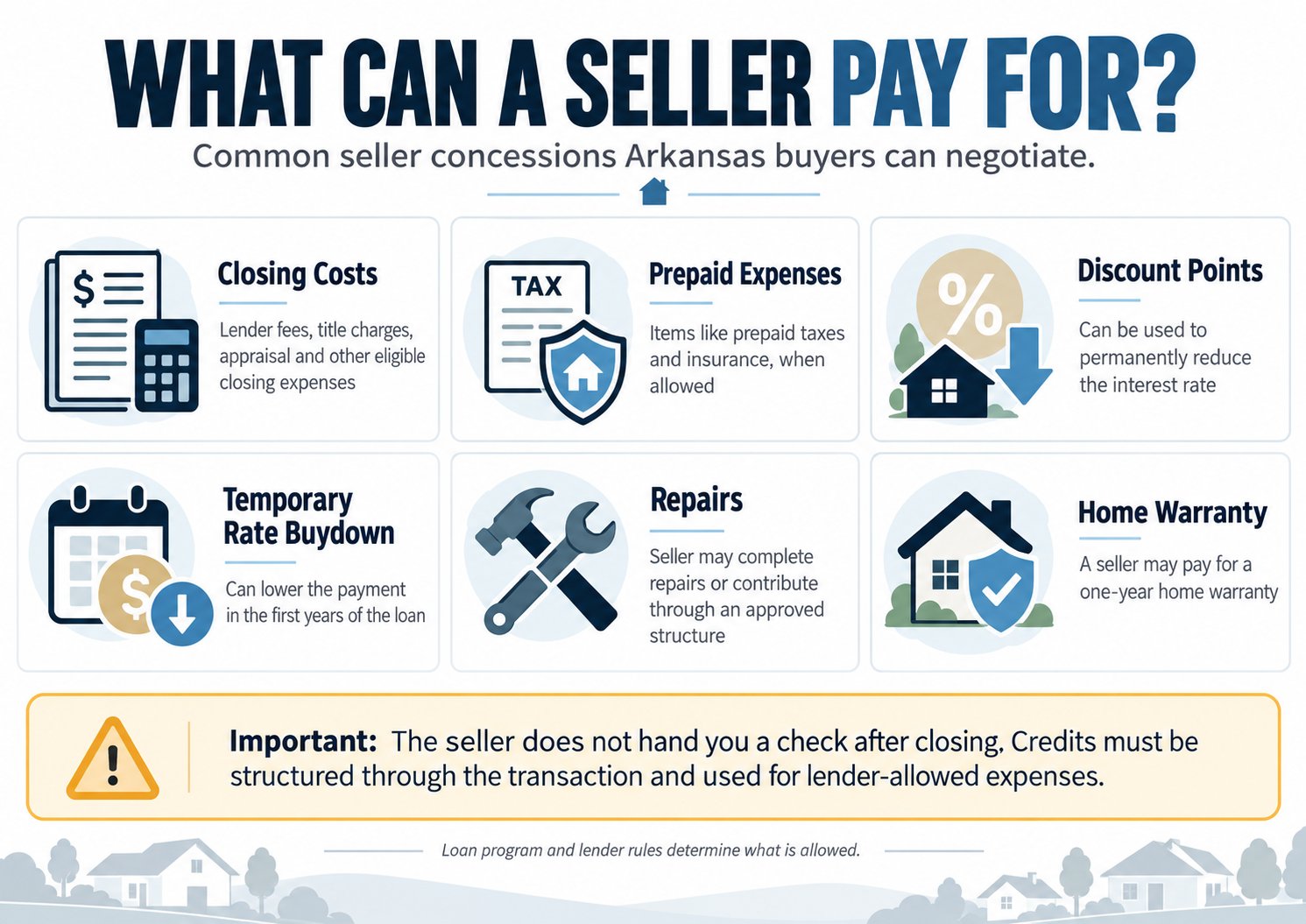
What can a seller actually pay for?
Depending on loan program and transaction: allowable closing costs, prepaid expenses, discount points, a temporary rate buydown, certain repairs, a home warranty, and other approved expenses.
What the seller is not doing is handing you a check afterward. The credit gets structured through the transaction and your lender decides which expenses qualify. You can't negotiate a $15,000 credit and pocket what you don't use.
The $10,000 question
This is the comparison every buyer should understand right now.
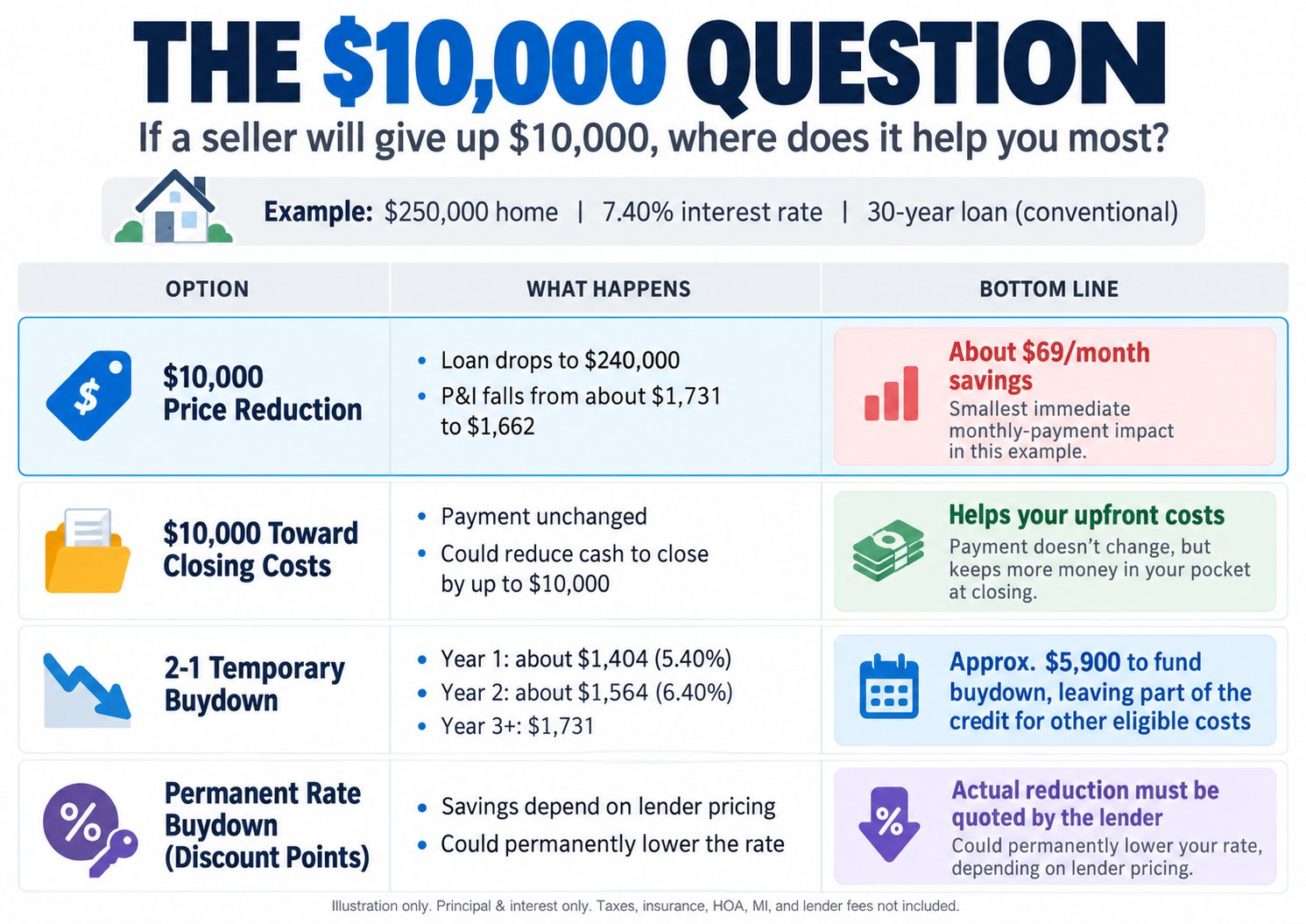
You're financing $250,000 at 7.40%. Principal and interest runs about $1,731 a month. The seller is willing to give up $10,000. Here are four ways to take it.
How the seller uses $10,000 | Effect on your payment |
|---|---|
$10,000 price reduction | Loan drops to $240,000. P&I falls to about $1,662 — roughly $69/month |
$10,000 toward closing costs | Payment unchanged, but you could bring up to $10,000 less cash to closing |
2-1 temporary buydown | About $1,404 in year one (5.40%), $1,564 in year two (6.40%), then $1,731 from year three. Funding that costs roughly $5,900, leaving part of the credit for other costs |
Permanent rate buydown (discount points) | Savings depend entirely on that day's lender pricing — points and rate reductions aren't linear. A $10,000 credit could permanently lower the rate, but only your lender can quote the actual reduction |
Look at what that actually says.
The price reduction — the thing nearly every buyer asks for first — is the weakest option on the list. Ten thousand dollars off saves $69 a month.
The closing cost credit doesn't change your payment at all, but it can leave close to $10,000 in your bank account. If you can handle the payment but you're scraping cash together, that's often the most valuable version by a wide margin.
The 2-1 buydown cuts your payment $327 a month in year one and $167 in year two, and only costs about $5,900 — meaning the remaining $4,100 can go somewhere else.
Permanent points lower the rate for the life of the loan, which makes them the strongest option if you genuinely plan to keep the mortgage a long time. But what $10,000 actually buys changes daily and isn't a straight line — get it quoted before you count on it.
There's no universal winner. It depends on your cash position, your loan, how long you expect to own, and what your lender can actually offer. But notice that the option most buyers reach for first is the one that does the least.
One warning on temporary buydowns
A temporary buydown doesn't change your actual rate. Money sits in an account at closing and subsidizes part of your payment for two years, then it's gone.
You still have to qualify under the lender's rules — the VA, for instance, requires you to qualify on the full payment that applies after the buydown ends.
Never buy assuming you'll refinance before it expires. The full payment has to be affordable on its own. If it isn't, you don't have a buydown — you have a problem on a timer.
How much can the seller actually contribute?
This is where loan program matters, and where buyers get into trouble.
Conventional loans under Freddie Mac guidelines generally cap financing concessions at 3% when LTV is above 90%, 6% when LTV is above 75% through 90%, and 9% at 75% LTV or below. Investment properties are generally 2%.
FHA generally allows interested-party contributions up to 6% of the sales price toward eligible costs and prepaids.
USDA generally limits seller and other interested-party contributions to 6% of the sales price for eligible purposes.
VA is different and frequently misunderstood. The VA permits sellers to pay certain normal buyer closing costs, while items the VA specifically defines as seller concessions are generally capped at 4% of the home's reasonable value. A seller-funded temporary buydown counts toward that 4% — while ordinary discount points and certain standard closing costs are treated differently.
That last distinction matters. "VA allows 4%" does not mean every dollar the seller pays lands in the same 4% bucket. Have your lender tell you exactly how a proposed concession will be treated before you write the offer.
Repairs
Repairs are often part of the negotiation, but structure matters more than the dollar figure. Sometimes the seller completes the work before closing; sometimes a lender-approved credit is cleaner.
What doesn't happen is the seller handing you $15,000 and wishing you luck with the roof. Your lender has an interest in the property's condition, and with government-backed financing some repairs may have to be done before the loan can close.
So when an inspection turns up something major, there are two questions: will the seller pay for it, and how will the lender let us structure it?
Which houses actually say yes?
Days on market is the first thing I check, and it costs nothing to ask for.
A house that listed yesterday with several showings booked is one negotiation. A house sitting 60 days with two price reductions is an entirely different one.
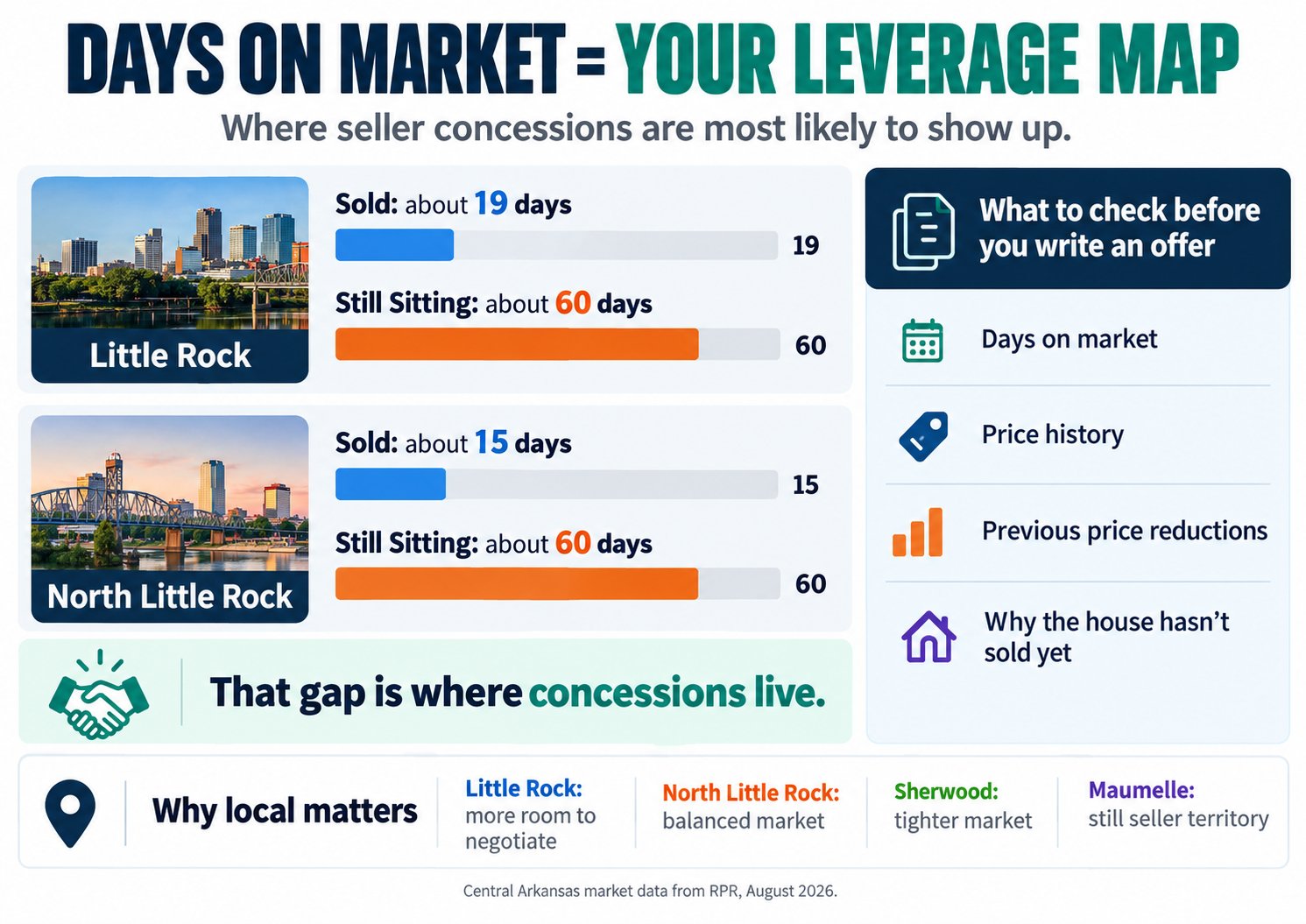
In August, homes that sold in Little Rock went under contract in about 19 days, and in North Little Rock about 15. But the median home still sitting in both cities had been listed 60 days.
That gap is where concessions live. Before you write on anything, ask for days on market and price history. Then ask the more useful question: why hasn't this house sold yet?
You can ask for both
Price and concessions aren't an either/or — roughly 15% of recent buyers got both.
Say a house is listed at $300,000 and has been sitting 75 days, and the comps support closer to $290,000. There's nothing wrong with offering $290,000 and asking for closing cost help. The seller can accept, reject, or counter. But nothing requires you to pick one.
If you're selling: cut the price or offer a concession?
This question matters just as much from the other side.
Say you're considering a $10,000 price reduction because your house has been sitting. Before you do it, ask what problem you're actually solving.
If buyers aren't showing up at all, your price is probably too high. A concession doesn't fix a house buyers won't come see. Price is what gets people through the door.
But if you're getting showings and buyers like the house, yet keep stalling on the payment or the cash to close — that same $10,000 directed at their financing may create a far larger perceived benefit than taking it off the price.
Remember the math. Cutting $10,000 off that $250,000 loan moved the payment $69 a month. A 2-1 buydown with the same money moved it $327 in year one — and cost less than $6,000.
That doesn't mean concessions substitute for correct pricing. They solve a different problem. Price gets people through the door. Terms get the contract signed.
Leverage isn't permission to write bad offers
More negotiating power doesn't mean every Arkansas house deserves a lowball. A well-priced new listing in Maumelle may give you almost no room. A stale listing in Little Rock may give you plenty.
The goal isn't to beat the seller. It's to find where the seller has flexibility and direct it where it does the most good.
The bottom line
With rates around 7.4% and seven straight weeks of increases behind us, negotiating only on purchase price leaves money on the table.
A $10,000 price reduction saves about $69 a month on a $250,000 loan. The same $10,000 could preserve thousands in cash, fund a temporary buydown worth $327 a month in year one, buy down the rate permanently, cover repairs, or be split across several of those.
And sellers need to understand the same thing. If your house isn't selling, another price cut isn't automatically the answer. Figure out why buyers aren't moving forward first, then solve that specific problem.
Looking at a specific house? Send it to me. Call or text 501-988-3758 or email [email protected]. I'll pull the comps, price history, days on market, prior reductions, and current competition, and tell you where I think there's actually room to negotiate. No pressure, no pitch.
Buying your first home? I teach a free online first-time homebuyer class covering financing, assistance programs, negotiating, and the entire process.
Mortgage rates change daily. Payment examples use a 7.40% rate for illustration and include principal and interest only — taxes, insurance, mortgage insurance, HOA dues, and loan fees are excluded. Buydown costs and rate reductions are set by your lender and will vary. Seller concession limits and allowable expenses depend on loan program, lender, LTV, property type, appraisal, and the individual transaction. Confirm any proposed structure with your lender before writing an offer.
Zach Dunivan is a licensed Arkansas Realtor® with Coldwell Banker RPM Group and the founder of Dunivan Real Estate, serving Little Rock, North Little Rock, Maumelle, Conway, Benton, Bryant, Sherwood, and Central Arkansas. This article is informational only and is not lending advice.
Real Advice. No Pressure. No Fluff.